
Dinghy Use
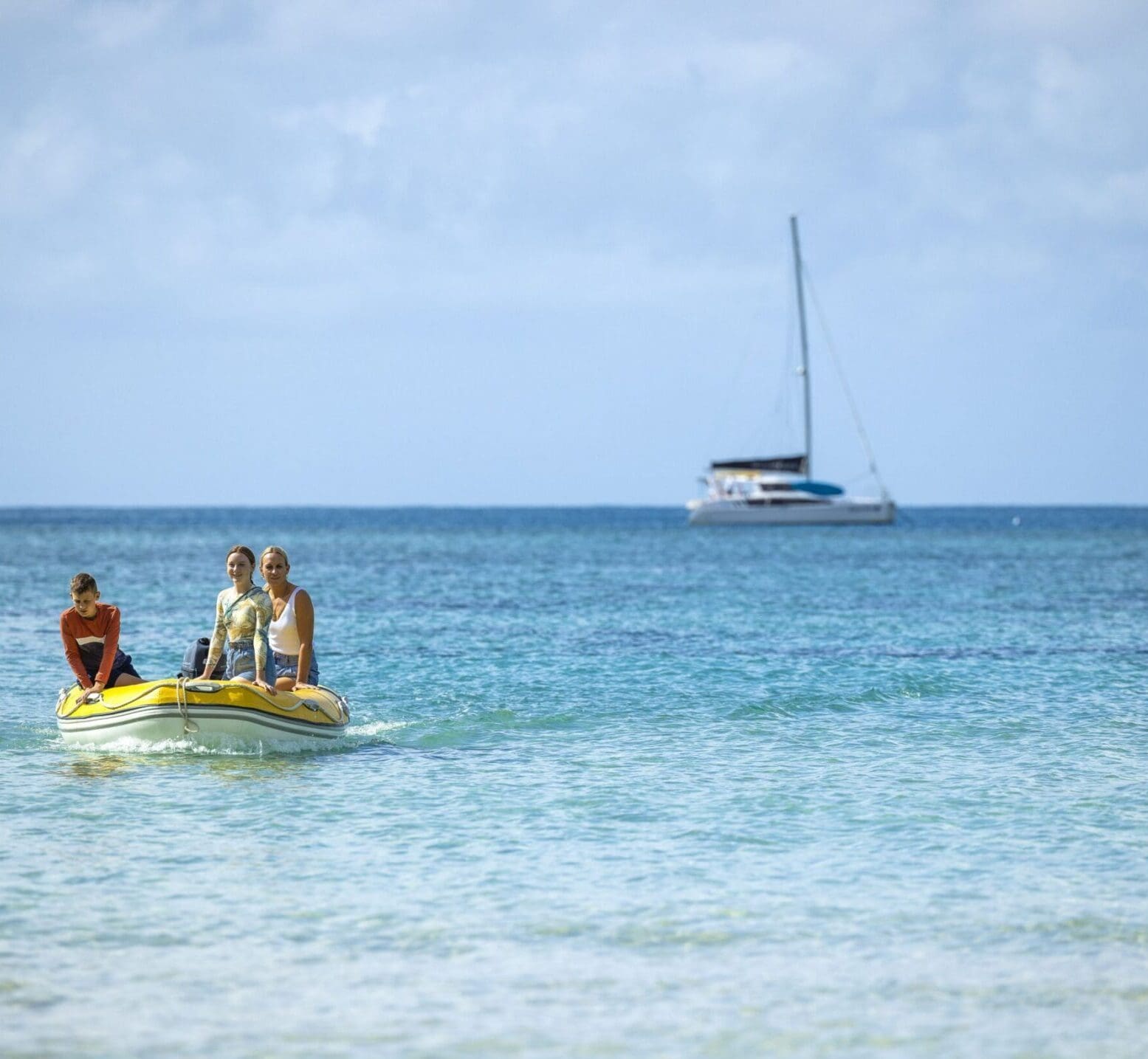
Your dinghy is your ticket to the beach. It takes you from the boat to white sand, walking tracks and the shore, and it’s also your life raft, so it pays to look after it. These tips will help you get ashore and back without a hitch. Your briefing covers how to launch and stow the dinghy on your boat.
Quick Facts
| Dinghy type | Rigid inflatable with aluminium hull and 6 hp outboard |
| Range | Within 500 m of shore and in sight of your main boat |
| Tide to get ashore | At least 1.2 m over fringing reef or rock |
| Overnight | Stored up in the davits |
| Children aged 1 to 12 | Life jacket required in the dinghy |
What comes with the dinghy?
Every boat has a rigid inflatable dinghy with an aluminium hull and a 6 hp outboard. On board you’ll find:
| Paddles | An anchor with 10 m of rope |
| Bow and stern lines | A bailer |
| A fuel tank and tray | Flares in a watertight container |
What are the rules for using the dinghy?
These rules keep you safe and keep your insurance cover in place.
- Stay within 500 m of the shore and in sight of your main boat
- Fit the outboard safety lanyard to the driver’s wrist every time
- Children can only drive the dinghy under the direct supervision of a competent adult
- Children aged 12 months to 12 years must wear a life jacket
- At night, take a torch to use as an all-round light, and everyone wears a life jacket
- Store the dinghy up in the davits overnight
- No smoking in the dinghy, as petrol is highly flammable
How do I plan a trip ashore?
Think about the wind and the tide before you go. As a rule, stay upwind of your boat and other boats in the anchorage, so if the motor stops, you can paddle or drift home.
Tides matter most. Where the shore has fringing reef or rock, you need at least 1.2 m of tide over the reef to get ashore and back. Many anchorages aren’t reachable below that, so check the tide tables before you go or you could be stranded until the tide returns.
How do I get in and out safely?
Bring the dinghy alongside the boat or in between the hulls to board. The metal leading edge will damage the transom steps if you come straight in. Before casting off, check the dinghy is fully inflated, the fuel fittings are secure, you have enough fuel, and you know how to raise the outboard.
How do I approach the beach?
Many anchorages have a bank of very shallow coral about halfway between the boat and the beach. Approach slowly with someone watching ahead. Before you reach the shallows, stop the motor, raise it and paddle the last stretch.
If the propeller hits coral while in gear, loose coral jams it against the guard and usually destroys the gearbox. You’d be relying on paddles or a tow to get back, then a return to base to swap the outboard, and the repair is expensive.
Watch out for swimmers, snorkellers and divers, and slow right down near them. A blue and white flag means divers are below, so stay well clear.
Where do I leave the dinghy ashore?
- Anchor the dinghy out in a few metres of water on a falling tide, or pull it up the beach on a rising tide
- Never leave it at the beach without its anchor set
- Never drag it over rocks or coral, or let it dry out on them. Oysters and barnacles are razor sharp and will puncture the pontoons
- Don’t tie it to a fixed jetty, as it will rub on barnacles when the tide changes
How do I use the davits?
- Raise the dinghy all the way up and fit the brace lines tightly, so it can’t swing, chafe or swamp
- Remove the bung while it’s in the davits, so rainwater can drain
- Tie brace lines as shown at your briefing, never through the rubber handles
- Check all lines are secure before starting the main engines, so nothing can tangle in the propellers
- No one sits in the dinghy while it’s in the davits. The fittings will fail
Three Mistakes That Leave You Stranded
- Ignoring the tide. Below 1.2 m of tide, many beaches can’t be reached over the reef. Head ashore on a low or falling tide and you may not get back until it rises.
- Motoring into the shallows. One touch of coral with the motor in gear can destroy the gearbox. Stop, raise the motor and paddle the last stretch.
- Dragging the dinghy over rocks. Oysters and barnacles slice through the pontoons, and a punctured dinghy means a trip back to base for repairs.
Dinghy Use




1/5


Frequently Asked Questions
Can my teenager drive the dinghy? Anyone under 16 can only drive the dinghy under the direct supervision of a suitably qualified adult.
Can I take the dinghy to explore a nearby island? Only if you stay within 500 m of the shore and in sight of your main boat. For anything further, move the main boat.
Is fuel for the dinghy included? No. Dinghy fuel is charged at the end of your charter, when our team helps you refuel at Coral Sea Marina. A tank goes a long way on short trips ashore.
Can I use the dinghy after dark? Yes, for short trips. Take a torch to use as an all-round light and make sure everyone wears a life jacket. Raise the dinghy into the davits before you go to bed.
Can I tow a stand up paddleboard behind the dinghy? No. Paddleboards must not be towed behind the dinghy or the main boat.
What if the outboard won’t start? Check the lanyard is clipped on, the motor is in neutral and the fuel bulb is firm. Still no luck? Paddle back if it’s safe, or contact us by VHF or phone.