
How to Reduce Fuel Costs on a Whitsundays Bareboat Charter
Fuel is part of every bareboat holiday in the Whitsundays, whether you choose a sailing catamaran or a power catamaran. Reducing the amount of fuel, and associated costs, is easy with our simple tips.
Just like a rental car, your boat is full of fuel at the beginning of your charter and you top it up at Coral Sea Marina before disembarking.
The good news? Keeping your fuel costs under control is usually quite simple. Cruising at 8 knots instead of 9–9.5 knots can save a significant amount of fuel over a 7-night charter, often for only a small time difference.
It might sound almost too easy, but cruising at higher RPM burns considerably more fuel, often without making much difference to your arrival time. In other words, going harder on the engines can mean spending more money for only a few minutes saved.
Our number one tip to save money is to go slow and enjoy the glorious views of the Whitsundays!
Why speed matters more than you might think
One of the biggest factors affecting fuel consumption is engine speed.
Many guests assume that pushing the engines a little harder will get them there much faster. In reality, increasing speed often burns a lot more fuel for very little time saved.
For the example below, we are assuming there is no wind and that both a sailing catamaran and a power catamaran are using their engines for the same amount of time.
Over a 7-night charter, increasing speed from 8 knots to 9–9.5 knots may add approximately:
-
90 extra litres per engine on a sailing catamaran
-
190 extra litres per engine on a power catamaran
A real Whitsundays example: Nara Inlet to Whitehaven Beach
Let’s look at an average journey in the Whitsundays.
The distance from Nara Inlet to Whitehaven Beach is approximately 15 nautical miles.
At 9 knots, this trip would take around 1 hour and 40 minutes.
At 8 knots, it would take around 1 hour and 50 minutes.
That is only a difference of about 10 minutes.
So the real question becomes: is saving 10 minutes worth using nearly double the fuel? We don’t think so!
Slowing down a little can make a big difference to your fuel use, your costs, and the overall feel of your holiday. After all, this is the Whitsundays, not a racecourse.
Remember – slow down, run your engines as advised by our Operations Team during your briefing and enjoy your holiday!
-
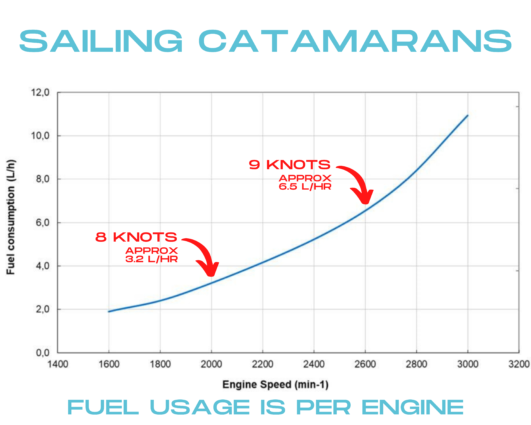
- Fuel usage at 8 knots vs 9.5 knots on Whitsunday bareboat charters
-
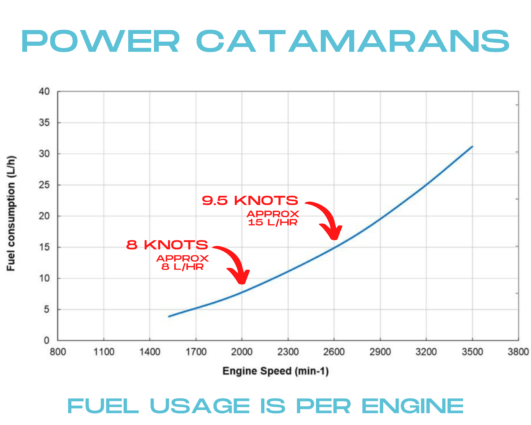
- Fuel use rises sharply with only a small increase in cruising speed.
*These examples are based on our fleet fuel-use comparisons under typical motoring conditions.
FAQs About Fuel on a Whitsundays Bareboat Charter
Do I pay for fuel at the end of my charter?
Yes. Your vessel starts with full fuel tanks, and at the end of your charter it is topped up.
Do we need to top up the fuel mid-charter?
No, unless you are on an extended charter of 15 nights or more. Refuelling is only done by our staff at Coral Sea Marina
Does the dinghy use fuel too?
Yes. Fuel consumption includes both your main vessel and your dinghy.
Will going faster save much time?
Usually, not as much as people expect. Even a noticeable increase in speed may only save a few minutes on a typical journey, while using much more fuel.
Do sailing catamarans use less fuel than power catamarans?
Generally, sailing catamarans use less fuel than power catamarans when motoring, although actual usage depends on conditions, itinerary and how the vessel is operated.
What is the best way to reduce fuel costs on charter?
Cruising at a sensible speed and following the advice given in your pre-departure briefing are two of the easiest and most effective ways to reduce fuel use.
Will your team explain fuel-efficient cruising before departure?
Yes. Our Operations Team will brief you on how to operate your vessel efficiently and confidently before you leave Coral Sea Marina.