
Great Barrier Reef Marine Park
The Whitsundays sit at the heart of the Great Barrier Reef Marine Park. Boating, sailing, snorkelling, turtles, coral spawning and whales, all explained.

The Great Barrier Reef Marine Park includes the mainland coast around Airlie Beach, the Whitsunday Islands, and the outer reef. The same coral and fish species found on the outer reef also thrive on the inner, fringing reefs that surround the islands.
The Whitsunday Islands lie in the lagoon between the shore and the outer reef, right at the heart of the Marine Park. Coral grows towards sunlight and cannot grow above the low tide mark, so both the inner and outer reefs stay covered by water most of the time, exposed only at very low tide.
Boating on the reef
Whitsunday Escape provides charts, guides and a full area and boat briefing covering where to anchor each night. When anchoring, your boat needs protection from waves and wind, and there are many anchorages offering all weather protection. Coral reef surrounds most of the Whitsunday Islands and coast, extending anywhere from a few metres to a few kilometres offshore. Large reef areas comparable to the outer reef itself are found at:
- Langford Island
- Black Island
- Hayman Island
- Saba Bay
- Hazelwood Island
Many of these reefs have been protected from fishing for decades, keeping the fish and wildlife pristine. Live coral grows from a depth of 20 metres right up to the surface at low tide, so prudent navigation is essential.
Sailing the reef
Sailing is one of the most popular ways to explore the Marine Park, and the quality of the fringing reefs is considered comparable to the outer reef itself.
- The island reefs are protected from ocean swells by the outer reef
- The 74 islands of the Whitsundays provide safe anchorages
- The Whitsundays sit at latitude 20°, with tropical trade winds year round, the same distance south of the equator as Hawaii is north
- Whitsunday Escape has a large number of sailing catamarans in the fleet, so there’s a boat to suit every group
Snorkelling the reef
The Marine Park is home to a huge range of marine life, including whales, turtles, giant clams and clownfish, in warm water year round. Snorkelling gear is provided free of charge. A few favourite spots:
- Blue Pearl Bay, west Hayman Island, one of the most popular spots, with a coral beach and interesting nooks to explore
- Langford Island, with a long sand cay and plenty of sea grass, a favourite feeding spot for turtles
- Cateran Bay, north Border Island, diverse fish life, including curious batfish
- Luncheon Bay, Hook Island, home to a resident family of clownfish
- Katie’s Cove to Chalkie’s Beach, Haslewood Island, a long stretch of pristine reef at low tide
Coral spawning
Once a year, all coral species spawn en masse on the same night, a phenomenon that happens between October and January, most commonly in November or December, usually 3 to 4 days after the full moon. Corals simultaneously release masses of pink eggs and sperm into the water. Coral spawn is sometimes confused with trichodesmium, a natural reddish brown plankton bloom, also called sea sawdust, that forms when the water is warm and conditions are calm.
Turtles
Six of the world’s seven turtle species visit the Whitsundays to feed, breed and lay eggs. They nest on Whitsunday Island beaches from November to February, and their tracks are often visible on the sand the following morning. Eggs hatch from January onwards. Turtles are found throughout Whitsunday waters, with the shallows of Tongue Bay, Apostle Bay and Dugong Inlet especially popular.
Whales and dolphins
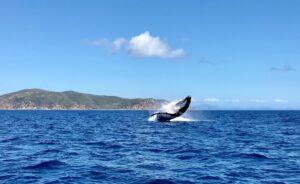
Around 30 species of whale and dolphin live in the Marine Park. Humpback and dwarf minke whales visit the warm Whitsunday waters every winter, from June to September, to calve and breed. For the full guide to whale behaviour, safe viewing distances and boating rules around whales, see our Whales page.
Facts About the Great Barrier Reef
- Became a World Heritage area in 1981
- One of the Seven Natural Wonders of the World
- The largest living structure on the planet, visible even from space
- One of the most complex ecosystems in the world
- Covers more than 344,000 square km, from the northeast tip of Australia to Bundaberg
- Hard corals grow at an average rate of 1 to 1.5cm a year
- Home to more than 600 types of coral and more than 1,600 types of fish
The Great Barrier Reef
The Great Barrier Reef


1/6


